Recent Post

Showing posts with label condensation. Show all posts

Claisen Condensation

Theory and Defination :


When treated with a strong base such as sodium ethoxide, two molecules of a carboxylic ester with two α hydrogen combine to give a β-keto ester in a reaction called the Claisen condensation.

It seen that Claisen condensation of esters is very similar to aldol condensation .The enolate form of one ester molecule carries out nucleophilic attack on the carbonyl carbon of another ester molecule.
How Claisen condensation differs from aldol condensation illustrates a general difference in the reactivity of esters vs. aldehyde and ketone.
In Claisen condensation, the enolate form of one ester molecule approaches another, similarly to aldol condensation, but, in this case, the tetrahedral intermediate resolves itself along an acyl substitution pathway. Both the aldol and Claisen condensations begin with an α-substitution, but in aldol condensation the overall pathway corresponds to nucleophilic addition, while Claisen condensation resolves itself in the manner of an acyl substitution reaction with sp2-hybridization returning with the departure of the leaving group.


General Reaction with illustration :


The most commonly used strong base in organic reactions, hydroxide ion, is not suitable for Claisen condensation because it could cause saponification of the ester. The base of choice in Claisen condensation is the alkoxide ion corresponding to the alkoxy group in the ester. Other alkoxides could cause trans-esterification of the ester. Since the β-ketoester formed in Claisen condensation is converted to the corresponding enolate ion by the base, in order to isolate the β-ketoester, when the reaction is complete, the reaction mixture needs to be acidified.

Mechanism:


Step 1: The alkoxide ion deprotonates the enolizable ester reversibly.


Step 2 and 3: Enolate ion 1 undergoes a nucleophilic acyl substitution with the unreacted ester to give the β-ketoester.


Step 4: The alkoxide ion deprotonates the β-ketoester irreversibly.


Step 5: The acid protonates enolate ion 2.


 Example and Application :


1)an intra molecular rearrangement


Benzoin Condensation

Theory and defination :

The Benzoin Condensation is a coupling reaction between two aldehydes that allows the preparation of α-hydroxyketones.The homocoupling of benzaldehyde gives the parent benzoin.The first methods were only suitable for the conversion of aromatic aldehydes.
The modifications of the benzoin condensation include the use of acylsilanes as well as imine derivatives in place of one aldehyde partner.

 General Reaction :


Illustration as below,


Mechanism:

Addition of the cyanide ion to create a cyanohydrin effects an umpolung of the normal carbonyl charge affinity, and the electrophilic aldehyde carbon becomes nucleophilic after deprotonation: A thiazolium salt may also be used as the catalyst in this reaction (see Stetter Reaction).


A strong base is now able to deprotonate at the former carbonyl C-atom:


A second equivalent of aldehyde reacts with this carbanion; elimination of the catalyst regenerates the carbonyl compound at the end of the reaction:


Example and Application :


The reaction can be extended to aliphatic aldehydes with base catalysis in the presence of thiazolium salts; the reaction mechanism is essentially the same. These compounds are important in the synthesis of heterocyclic compounds. The addition is also possible withenones; for instance methyl vinyl ketone is a reagent in the Stetter reaction.
In biochemistry, the coenzyme thiamine is responsible for biosynthesis of acyloin-like compounds. This coenzyme also contains a thiazolium moiety, which on deprotonation becomes a nucleophilic carbene.
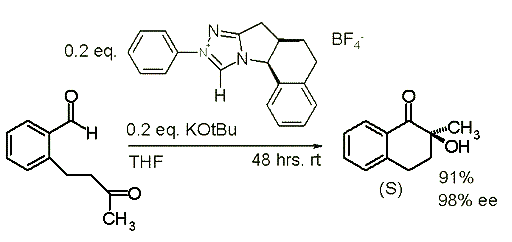
In one study, a custom-designed N-heterocyclic carbene (NHC, the framework is related to thiazolium salts) was found to facilitate anenantioselective intramolecular benzoin condensation.


This finding was confirmed in another study with a slightly modified NHC using DBU as the base instead of potassium tert-butoxide.


Acyloin Condensation

The acyloin condensation usually involves the reductive di-merisation of a carboxylic ester, although acid chlorides and the anhydrides have been used. The reducing agent is in an alkali metal and the product is an ene-diolate. Two gram-atoms of metal are required for each mole of ester with the concomitant formation of a mole of akoxide and one-half mole of the ene-diolate. Oxidation of acyloins to diketoes can be accomplished by a variety of reagents. Acyloins can be reduced to ketones by various modifications of the Clemmenson technique. Under mild conditions the ketone will dominate. This chapter presents a complete picture of both the linear and cyclic acyloin condensation with particular emphasis on developments since 1960. The discussion is closely limited to the acyloin condensation and its modifications.


The bimolecular reductive coupling of carboxylic esters by reaction with metallic sodium in an inert solvent under reflux gives an α-hydroxyketone, which is known as an acyloin. This reaction is favoured when R is an alkyl. With longer alkyl chains, higher boiling solvents can be used. The intramolecular version of this reaction has been used extensively to close rings of different sizes, e.g. paracyclophanes or catenanes.


If the reaction is carried out in the presence of a proton donor, such as alcohol, simple reduction of the ester to the alcohol takes place (Bouveault-Blanc Reduction).
The Benzoin Condensation produces similar products, although with aromatic substituents and under different conditions.
When the acyloin condensation is carried out in the presence of chlorotrimethylsilane, the enediolate intermediate is trapped as the bis-silyl derivative. This can be isolated and subsequently is hydrolysed under acidic condition to the acyloin, which gives a better overall yield.

Mechanisms:
 The mechanism of the following reaction is not well understood yet it has been assumed that the reaction went through by a DIKETONE intermediate as these diketone has been isolated in small amounts as by-product.
Since, the reaction proceeds in the presence of metallic Sodium, a radical reaction happens.


The metallic Sodium donates its electron to the carboxyl cardon to give an ionic complex. Now, with the loss of alkoxy groups from (2) produces the 1,2-diketone. Further, reduction gives Sodium salt of enediol. Finally, addition of acid yields 1,2-diol which tautamerizes to ACYLOIN as shown in step-4.
As, the miniscule trace of Oxygen can reduce the yield, the whole reaction is carried out in Oxygen free Nitrogen.

Application : Preparation of cyclic acyloins :–
This condensation has been used for preparation cyclic acyloins. Long chain dicarboxylic esters have been converted to large ring compounds without the use of dilution technique. It is used best for closing rings of ten members or more.

Preparation of CATENANE :–
CATENANE is a very interesting & unique compound with interlocking rings. It is formed when acyloin condensation was employed for ring closure with esters of 34-carbon di-carboxylic acids.